At least 50 logged dives
AOWD or equivalent certification
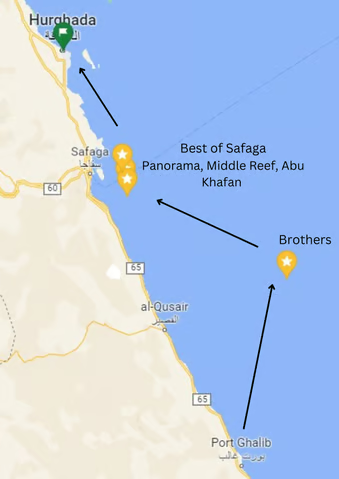
The “Brothers” are among the top 5 diving spots in the Red Sea. The two islands are about a kilometer apart and are actually mountain peaks formed by volcanic activity. The Big Brother is located to the north, and the Little Brother is further south. The narrow, needle-like islands are surrounded by nothing but the open sea and, due to their distance from the mainland, can only be reached by safari boat. The islands rise from great depths and are classified as drop-offs. The steep walls are densely covered with hard and soft corals. Due to their location, strong currents can occur, which leads to high shark populations at the Brothers and has made them famous. Sightings of gray reef sharks, longimanus, thresher sharks, hammerhead sharks, or silky sharks are not uncommon.
Even from a distance, you can see the landmark of this dive site—the lighthouse, built in 1883.
The Numidia sank off the northern tip of the island in 1901. It was a 145-meter-long English merchant ship carrying railroad parts. The wreck lies upright on the sloping reef at a depth of between 8 and 85 meters. The cargo hold and the gallery are open and accessible to divers. Forty-six years later, another merchant ship sank on the western side—the Aida II. Due to a sudden change in weather, the ship sought shelter near the islands, struck a reef while docking, and immediately took on water. Today, the Aida lies at a depth of 25 to 60 meters. After all these years, nature has reclaimed the wrecks. The hulls and superstructures are beautifully overgrown with gorgonians, sponges, and soft corals.
On the southern plateau, there is a shark cleaning station. With a bit of luck, thresher sharks and manta rays gather here.
The “Little Brother” The steep edge of the west wall looks almost unreal. It’s bursting with color and life. The entire drop-off is teeming with marine life—huge sea fan colonies give way to dense forests of colorful soft corals. Monumental stony coral formations on the east wall provide shelter for a wide variety of reef fish. Longnose damselfish make their home in the gorgonians.
Groupers, porcupinefish, tropical triggerfish, pufferfish, boxfish, clownfish, and stingrays, as well as pulsating clouds of fiery-colored anthias. If you manage to ignore the wild jumble of reef fish for a moment and gaze out into the blue, you’re sure to be in for a surprise: snappers, mackerels, barracudas, tuna, napoleon fish, and sea turtles are not uncommon here. You certainly won’t get bored here.
“Father of the Mast,” a concrete pillar that once marked the northern end and has now been replaced by a state-of-the-art, automated beacon.
400-meter-deep drop-offs, strong currents—facts that unsettle many divers at Panorama Reef. But as soon as the word “big fish” is mentioned, you can already see the first ones jumping into their wetsuits. The deep blue and the vibrant colors of the corals create a beautiful contrast. In the summer, whale shark and manta ray sightings are not uncommon. Eagle rays, Napoleon fish, and large sea turtles have also made this their home and love to pose for the camera.
On the southern plateau, which drops to 35 meters, you’ll find huge gorgonians on a chimney. Hundreds of clownfish frolic in a vast field of anemones.
Translated from Arabic as “Father of the Depths”—this approximately 300-meter-long reef undoubtedly earned its name for good reason. It drops down into the deep blue to a depth of about 700 meters!!! A dive site that isn’t always easy to dive, as strong currents can occur here as well, yet it ranks among the best in all of Safaga.
At the beginning and end of the steep walls are two beautiful plateaus. The south side is mostly sheltered and is therefore often used as an anchorage for boats. Just below the water’s surface and sloping down to about 18 meters, you’ll find a stunning rock formation resembling columns that instantly captivates divers’ attention. If you have plenty of air, it’s worth circling the column several times at different depths, as the area is teeming with marine life. The trained eye can spot well-camouflaged stonefish, scorpionfish, and even crocodilefish among the corals.
The North Plateau is by no means less spectacular—quite the opposite. When weather conditions are good and the sea is calm, the north side can be dived. At a depth of about 22–28 meters, it extends into the open sea and drops vertically into the depths. At this point, there are two large coral blocks with fantastic growth. Here, large fish of all kinds can be spotted. Reef sharks, a school of resident barracudas, as well as turtles, Napoleon wrasse, and manta rays are among the local highlights here.
The nearly vertical eastern wall is adorned with beautiful soft corals, gorgonians, and black corals and is just waiting to be explored on a drift dive. About halfway down, at a depth of 17 meters, a deep crevice cuts into the wall, and shortly after, it continues as a canyon. The entire east wall is crisscrossed with many small caves, crevices, and magnificent overhangs, making it a wonderful home for many underwater creatures. As beautiful as this wall is to look at, please never forget to glance out into the open water!
The west side isn’t as spectacularly overgrown, but it’s still good enough for a nice drift dive.
The exact route and dive sites are subject to weather conditions and may differ from the planned itinerary.
The exact route and dive sites are subject to weather conditions and may differ from the planned itinerary.