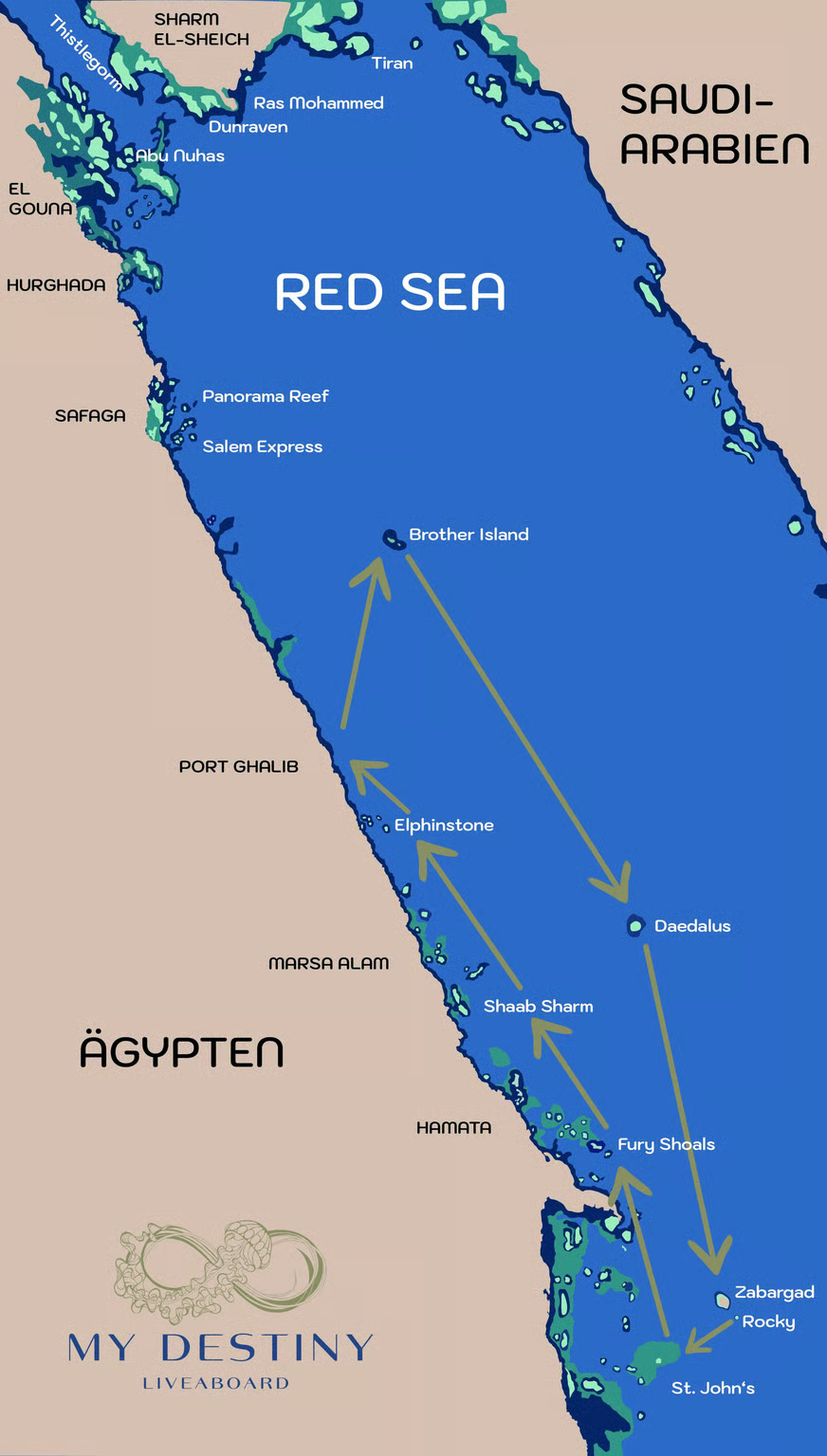
When the lighthouse was built in 1863 on Daedalus Reef (Arabic name: Abu Kizan), no one could have imagined what was happening beneath the surface at this hotspot. The reef became famous for its large population of Hammerhead Shark. The good news: the school is resident and always there. The bad news: you won’t always see them, as they often patrol at depths beyond the reach of recreational divers. Daedalus is a reef of unlimited possibilities—virtually anything the Red Sea has to offer can pass by here.
Sightings of Thresher Shark have also become increasingly common. Alongside the Brothers Islands and select dive sites in the Philippines, Daedalus is one of the best places to encounter these elegant sharks with their distinctive long tails. The gentle giants also favor this site—multiple encounters with Manta Ray and even Whale Shark elevate this dive spot to world-class status.
However, the site also demands solid diving skills. Strong and constantly shifting currents are part of the daily routine and are exactly what attract the marine life. Being able to deploy a surface marker buoy is mandatory. Descending into blue water without any reef in sight can feel unsettling for some divers—but that feeling quickly disappears once the first “hammerheads” appear and you find yourself grinning so much that water leaks into your mask.
The southern plateau is more relaxed. From around 20 meters, a gently sloping plateau with numerous coral blocks (“ergs”) begins. Here you’ll find groupers, moray eels, and Napoleon Wrasse. Turtles gather around the many soft corals. Depending on the season, Oceanic Whitetip Shark and silky sharks are often seen beneath the liveaboard boats.
Zabargad Island owes its name to the 235-meter-high mountain on this small island, located about 71 km off the Egyptian mainland. In the past, mining was carried out here due to the belief that the island held rich sapphire deposits. Even today, there is plenty of activity on the water’s surface—but not by humans. Zabargad serves once a year as a nesting site for many Sea Turtle.
On the northeast side lies an unnamed wreck. The approximately 70-meter-long ship rests at a depth of 24 meters. The entire stern stands out with its intact superstructures—stairs, railings, davits—as well as portholes, hatches, and the bridge, making it a picture-perfect wreck.
On the southeast side, the upper reef area features numerous swim-throughs and small caves where, with a bit of luck, you can find Nudibranch and flatworms.
On the western side of Zabargad, alongside beautiful hard coral gardens, divers can explore the remains of the safari boat Neptuna, which sank here under mysterious circumstances in 1981. Originally used as a minesweeper, the vessel was later converted into one of the first safari boats in the Red Sea.
On April 29, 1981, serious seamanship errors while relocating the vessel to another anchorage caused the Neptuna to collide with the reef and sink stern-first within a very short time.
Now comes the mysterious part: the wreck has been considered lost ever since. Only scattered traces of the accident—such as a generator, several suitcases, a radar device, and a scuba tank—can be found on the sandy seabed at around 24 meters. As the reef at this point slopes only gradually, the vessel could not have slid far into deeper water, suggesting that the Neptuna must still lie somewhere nearby.
It remains one of the many enduring mysteries of the Red Sea.
Rocky Island (often simply called “The Rock”) is a rather inconspicuous small island. Its walls drop off steeply and are covered in a stunning array of soft corals, gorgonians, sponges, black corals, and fan corals. The site is teeming with life: nudibranchs, longnose hawkfish, shrimps, and much more make every macro lover’s heart beat faster.
Rocky is often exposed to strong currents, which in turn attract larger pelagic species such as Hammerhead Shark, Manta Ray, and Dolphin, all drawn in by the rich feeding opportunities.
Der wohl weltweit bekannteste Tauchspots in ganz Ägypten, verdankt seinen Namen „roter Felsen“ einer roten Felsformation auf dem Festland, welche die Seefahrer früher als Orientierungshilfe nutzten.
Das ca. 600m lange spindelförmige Riff liegt nur 9km von der Küste Ägyptens entfernt und ist ein beliebter Spot für tägliche Ausfahrten verschiedener Tauchbasen und ein Highlight am Ende einer jeder Tauchsafari. Obwohl ein hoher Tauchbetrieb vorherrscht, lassen sich die Unterwasserbewohner davon nicht abhalten diesen Ort aufzusuchen.
Elphinstone ist für sein hohes Aufkommen an Weißspitzen-Hochseehaien (oder auch Longimanus) in aller Munde. Nirgendwo anders auf dem Globus ist die Wahrscheinlichkeit so hoch, eine der größten Haiarten anzutreffen. Manche Weibchen können eine Größe von bis zu 3m erreichen.
Bei Elphinstone handelt sich um ein DropOff mit einem Nord- und Südplateau. Die Steilwände fallen bis zu mehreren hundert Metern in das tiefe Blau ab – ein unheimlicher, aber schöner Kontrast zu den vielen farbenprächtigen Korallenarten des Riffs, insbesondere den violetten und rosa Weichkorallen und anmutigen roten Gorgonien – ihre Tentakel bewegen sich in den starken Meeresströmungen.
Je nachdem welche Strömung vorherrscht (meist von Nord nach Süd) startet man den Tauchgang am Nordplateau. Geübte Taucher beginnen den Tauchgang sehr tief auf Höhe des Ergs um die Chancen auf eine Sichtung von Hammerhaien zu erhöhen. Dann driftet man in reduzierter Tiefe weiter in Richtung Süden. Der Tauchgang endet im Freiwasser mit geschossener Boje, wartend auf die Longimani und das Beenden des Safety Stopps – dieser fällt schon mal länger aus, wenn die erste abgerundete Hairückenflosse gesichtet wurde und noch ausreichend Luft im Tank ist. Ein Auge sollte man jedoch während des ganzen Tauchgangs ins Blaue richten. Tümmler, Mantas, Marlins, Wal- und andere Haiarten können hier jederzeit vorbeiziehen.
Auf halben Weg zum Südplateau kommt einem meist schon ein riesiger ortsansässiger Napoleon entgegen. Er hat keine Scheu vor Tauchern und schaut diesen auch gerne tief in die Augen oder stupst sie liebevoll an. Für Tec-Taucher interessant und betauchbar, ist der Sarkophag, auch als Torbogen bekannt. Die Legende besagt, dass ein ägyptischer Pharao hier begraben liegt. Auch bei schwachem Licht ist die Form eines Sarkophags erkennbar und dieser ist mit Korallen übersät. Der Torbogen beginnt auf ca. 52 Meter und endet auf 62 Metern, hierzu muss man das richtige Luftgemisch in der Flasche haben.
Auch am Nordplateau haben Tec-Taucher eine gute Chance auf die Begegnungen mit Hammerhaien. Kein bisschen unspektakulärer, ist der Durchbruch am Nordplateau. Kurz vor dem Erg auf ca 50 Metern trifft man auf drei große Fächerkorallen, die den Eingang des Durchbruchs markieren. Danach geht es auf ca. 48 bis 53 Meter einmal durch das ganze Nordplateau. Dies liegt weit unterhalb der Tiefengrenze für Sporttaucher und darf und sollte nur mit der nötigen technischen Ausbildung und dem richtigen Luftgemisch betaucht werden.
The exact route and dive sites are subject to weather conditions and may differ from the planned itinerary.